2025
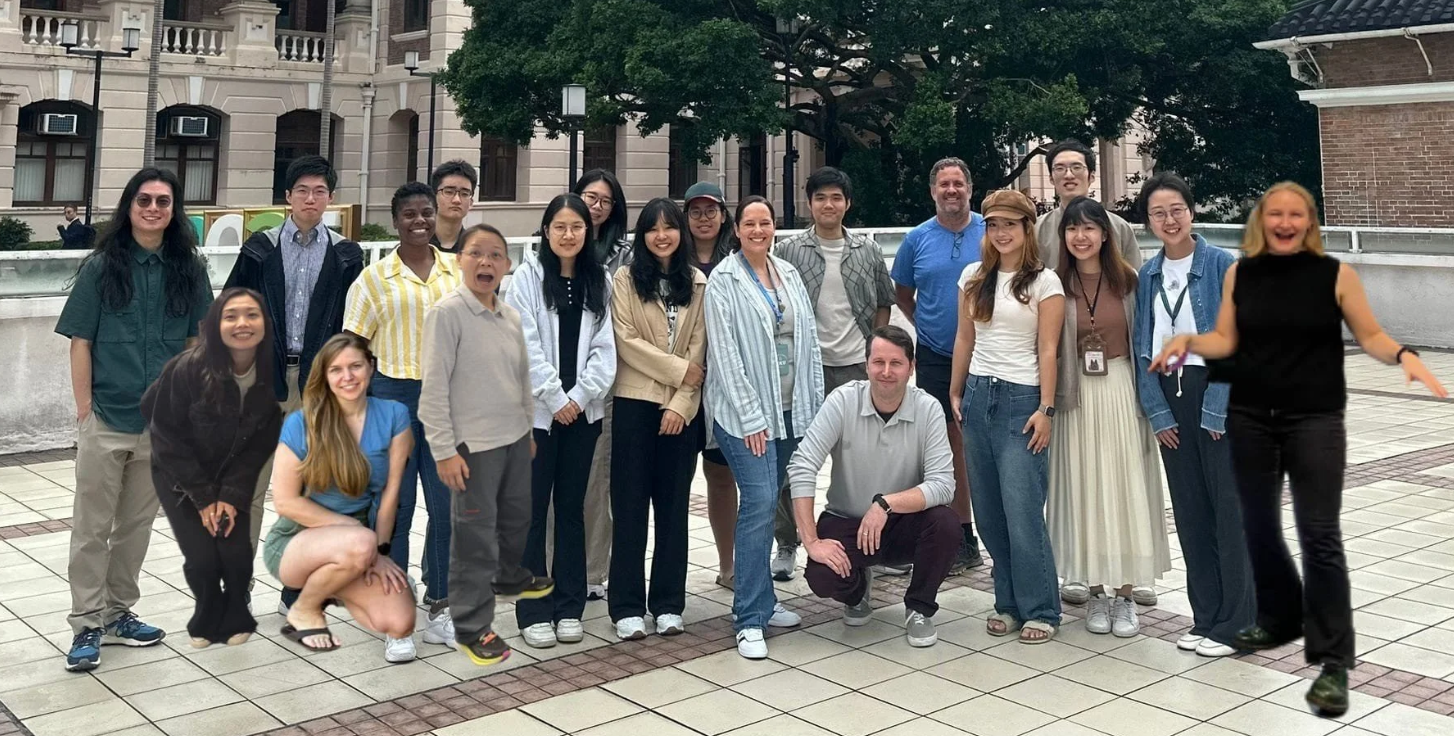
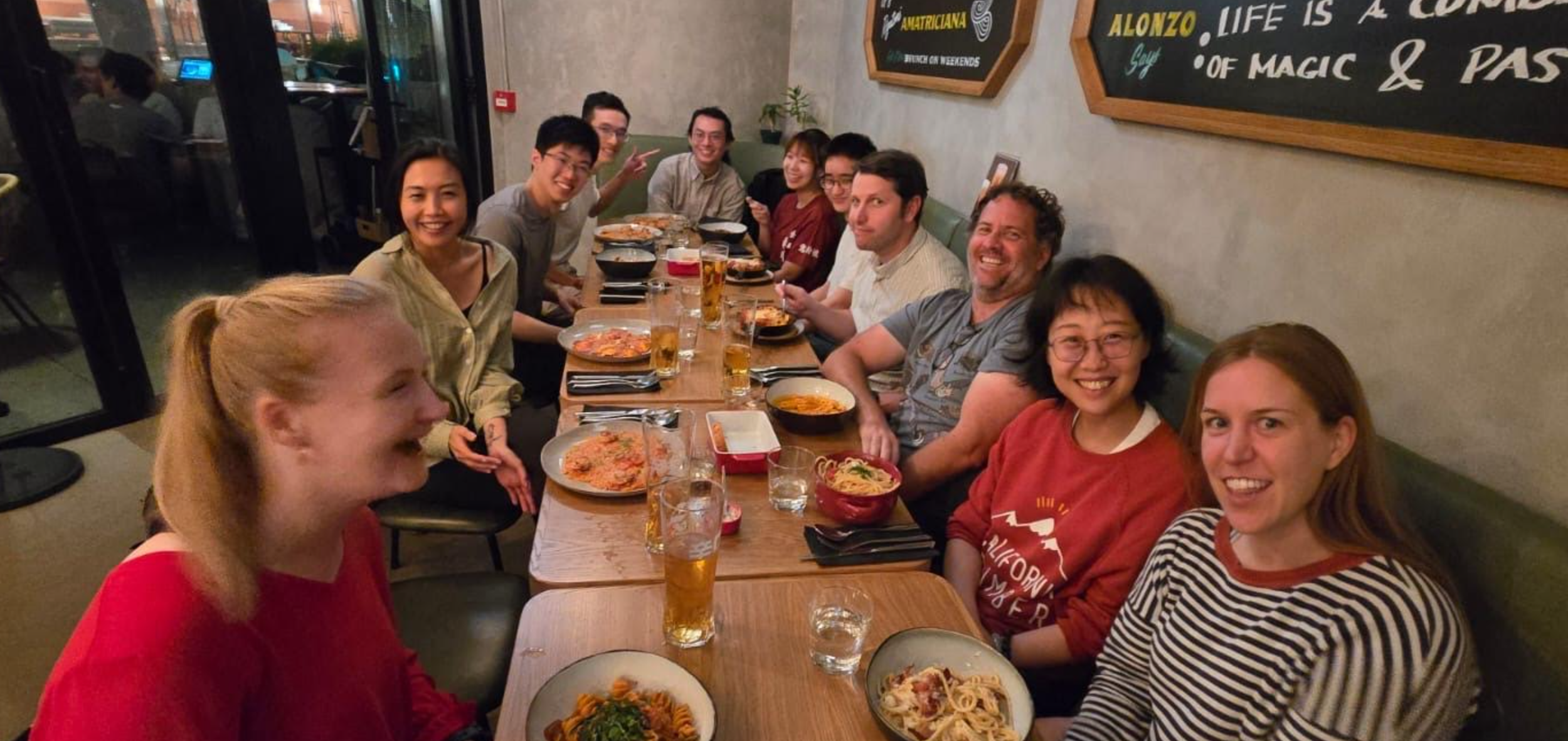
2025 was another busy year for the lab. Four PhD theses and one MPhil thesis were submitted in the year! Congrats to Even, John, Kelly, Tracey and Vincent. I attended a number of conferences including ATBC in Oaxaca, EntSoc in Portland, and AsiaEvo in Kunming. And I’ve been very busy teaching, covering four courses in the year including another successful field course in Borneo and a revamped Urban Ecology. For Urban Ecology we trialled a Course Based Undergraduate Research Experience (CURE) which was a lot of fun and very insightful.
Over the summer I stepped down as Associate Dean (Teaching & Learning) of the Science Faculty and stepped into a new role as Director of the School of Biological Sciences. Six months into my new role I’m very much enjoying the challenge… though it is very challenging. But I’m learning a lot and hopefully contributing to positive developments in the advancement of the School.
Meanwhile, the lab has continued to be busy and productive. We’ve finished off some long-standing projects, forged ahead on continuing work, and started some new stuff. I’ve highlighted a few papers below which will give you some insight into some of our work.
But I also encourage you to pre-order Crime and Pangolins! My advertising campaign for the book started this year but I expect it to ramp up in 2026 as the publishing date nears in April 2026. I wrote most of the book during my sabbatical in L.A. and Cambridge a couple years ago but it’s taken a while to finish it off and get it in shape for publishing. I’m eager (and yes, a bit anxious) for its release.
I’ve selected some papers to highlight from the year below but also wanted to give a special shout-out to a few others as well. Michel published his work on plasticity in thermal tolerance across habitats in Bicyclus butterflies in Evolutionary Ecology. Toby spearheaded a rather epic study in Global Change Biology on the effects of land-use change on global bee diversity, featuring contributions (data and otherwise) from more than 140 authors. Tracey led a detailed and thorough (yet nicely accessible) review on the use of stable isotope analysis in the wildlife trade in Biological Reviews. And I was happy to play a small part on an important paper linking tropical insect declines to stronger El Niños in Nature, led by Adam Sharp, Mike Boyle and Louise Ashton.
Here are some behind the scenes glimpses into some of the papers that came out of the lab this year…
Complex dynamics of multi-species aggregations of danaid butterflies in Hong Kong
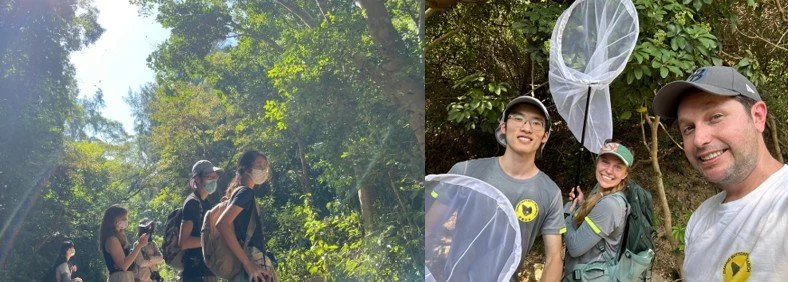
Sampling site on Lamma Island in 2021 (Left) with the team in the foreground and butterflies in the background. Lead authors (Right – Fung left and Emily center) during a survey on Lantau in 2024.
Four years ago, in the winter of 2021, an aggregation of thousands of butterflies appeared very close to my house on Lamma Island. Within a couple of weeks my lab conspired in a plan to track the butterflies in these aggregations and determine what was behind their dynamics – where were the butterflies going? Why do they choose certain sites? What are the species compositions of the aggregations? The Danaid Butterfly Research Hong Kong team was born.
In the beginning, Emily Jones, Yuet Fung Ling, and Nicole Yu led the effort and the four of us applied for funding through the Lantau Conservation Fund (some of the largest aggregations occur on Lantau). And it was funded in 2022! Nicole left soon after to do a PhD at Concordia while Emily and Fung took the lead in executing what wound up being a challenging effort logistically, with a lot of community engagement, coordination with different groups, and, of course, a lot of intensive field work.
This year Fung and Emily (and team) published a paper in the Journal of Insect Conservation which outlines some of the major features of these aggregations. We borrowed from a long-standing methodology applied in the study of monarch butterflies and used stickers to track individuals. We also added a website where users could upload images, where we could then verify butterfly identities. From 2021 through to Feb 2025, we tagged more than 15,000 butterflies and had 1,500 recoveries – more than half of the recoveries were photos from the public, demonstrating the unique power of community science efforts and engagement with the public. We also recorded 13 species of danaid during our research, with many aggregations hosting several at one time. Using mark-release recapture models we also estimated the size of the aggregations, often exceeding 5,000 and sometimes exceeding 10,000.
While none of our tagged butterflies were recorded outside of Hong Kong, we did observe 78 movements of butterflies with a median distance of 3 km and a maximum recorded movement of 17 km. The general directions of the movements were species-specific with Euploea often moving west (or southwest) while Tirumala limniace were largely moving east (or northeast). We also discovered distinct characteristics across the aggregations and can now roughly categorize them as either forested valley habitats or open sites, usually rich in pyrrolizidine alkaloid (PA) plants. Depending on the habitat, there tend to be different species associated (forested sites have a lot of Euploea while open sites are more Danaus-dominated) and different purposes.
Many mysteries remain as to what these danaids are doing and why. But they remain a special ecological phenomenon and we hope that the work conducted by Danaid Butterfly Research Hong Kong can help to conserve these species and extraordinary behaviors. This paper should serve as an important first step in providing key baseline info. And, importantly, none of this could have been done without assistance from colleagues and friends, both old and new. The acknowledgements section of this paper is appropriately very lengthy! That has been one of the true gifts of this research – the unique aggregation of butterflies and also tended to aggregate people.
No effect of light pollution on spiders but early season herbivory increases
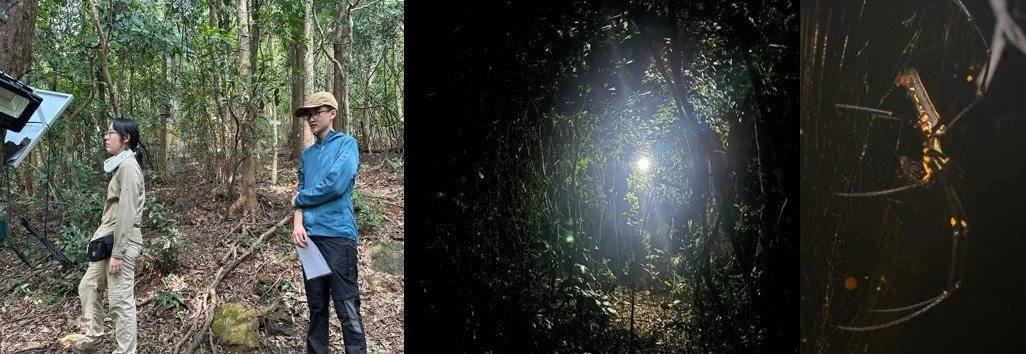
One of our study sites (Left – during the day) with Yiu Siu (left) and Yirong (Chester) Guo (right) collecting data. Another study site (Center) at night. And a Nephila pilipes spider (Right).
On Feb 4 2024 I was walking around Lamma Island and mulling over some ideas. I had been studying light pollution and biodiversity on a project with Louise Ashton and Caroline Dingle for some years by that point. I really wanted to investigate how light impacted growth of a large spider, Nephila pilipes. But previous efforts had not been successful. Then I had an idea! We could put lights out into undisturbed forests, set up plots and then measure spider growth over time. We could even measure herbivory rates to see whether changes in spider growth might affect herbivore density (and thus, herbivory).
Near the end of my walk I texted Caroline and Louise frantically with my idea. They approved, and supplemented how best to approach this. I then approached Chester, an undergraduate who had been working in my lab for a couple years at that point. I asked if he was keen to run an experiment like this. He was. We immediately started planning and we had the experiment up by April.
In brief, we set up lights in several secondary forest sites and had paired control sites (lights were set up and monitored but not turned on). We then surveyed spider numbers and size for three months, as well as herbivory rates. The results were unexpected – we found no effect of light on spider number nor size. But interestingly, we did find an effect of light on herbivory rates, which were elevated only in the early part of the wet season in lit sites.
We published the paper in Oct 2025 in The Science of Nature following a constructive review process. This is among the fastest I’ve seen a field-based study be designed, executed, written and published – all in the span of less than two years. The findings lend themselves to a range of next-step questions. Why are there elevated herbivory rates and why only in the early wet season? Why are the spiders seemingly unperturbed by light? Does the kind of light or intensity matter? We speculate on some of these questions in the paper. The data that Chester and team collected will hopefully aid in understanding how artificial light at night impacts tropical and subtropical biodiversity.
The distributions of butterflies across tropical Asia
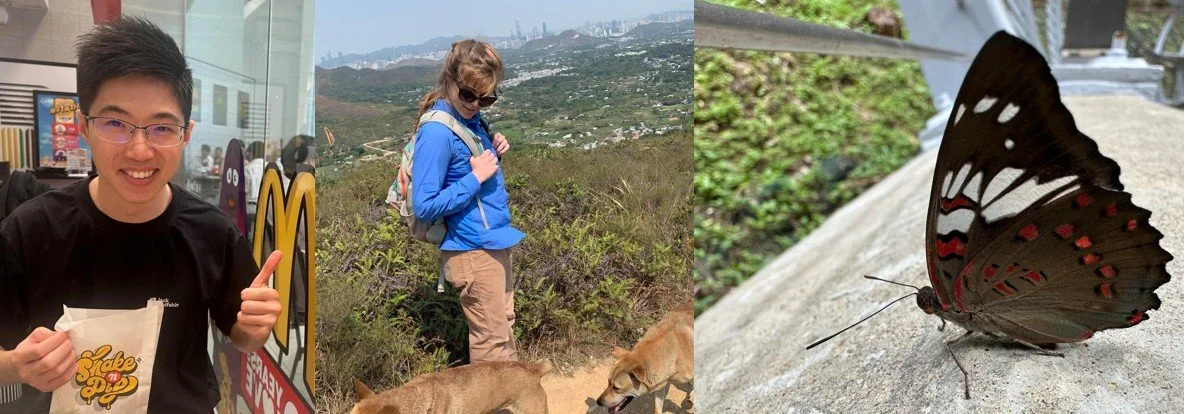
Eugene Yau (Left) and Emily Jones (Center) led the research documenting the distributions of butterflies across tropical Asia. A Euthalia lubentina (Right) is a butterfly whose distribution you can now look up via our paper if you are so inclined.
When I was postdoc (a lot of years ago) I had ideas for plotting the distributions of butterflies in tropical Asia. My thinking was that it could be tractable and that there would be tremendous value in such data for purposes of understanding climate change vulnerability in tropical insects. But for years, I ran into obstacle and after obstacle, and for many of those years the idea just percolated in the background of my head.
But in 2017 we finally started making progress. Initially, Shuang Xing had the idea to push this forward in coordination with SPARC (Spatial Planning for Protected Areas in Response to Climate Change). We wrote a proposal, got some funding through the Global Environmental Facility. Shuang left soon after for a new position and Toby Tsang took over. Our first results came out in 2019-ish and we were rather underwhelmed by the results. Our findings suggested that the best hotspots for butterfly diversity were cities, like Jakarta. We knew this wasn’t true, however, and we had good evidence that this was largely a result of spatial biases. People like to record butterflies in and around cities and that was inflating the diversity estimates.
Thanks to funding from a National Science Foundation China Excellent Young Scientist Award, I was able to investigate this in more depth. Emily Jones joined the team to compile records across the region and specifically target locations where we didn’t have much data. Emily worked painstakingly for more than a year to go through all sorts of records, published papers, book guides, reports, whatever we could find. Many undergraduates and part-time researchers also assisted on the effort.
The last piece of the puzzle was Eugene Yau (a PhD student co-supervised by Alice Hughes), who took an interesting in taking all of the data and running Species Distribution Models (SDMs) to estimate all of the distributions. When all was complete, we had more than 700,000 records representing 3,752 butterfly species. Not an easy task computationally but Eugene developed a range of workarounds to get the job done efficiently. When we completed the first set of analyses for these data the results looked a lot better than our first attempt – the year plus of data compilation we put into this (plus the modelling) had paid off well.
But how would we really be able to tell? We’re not experts of all of Asia. We (mostly Emily and Eugene) then pulled together an impressive team of butterfly experts from all over Asia and asked for input, data, suggestions, and anything else that could strengthen our model outputs. We received a lot of great suggestions for where our model wasn’t working well, reasons for gaps in the dataset, and taxonomic assistance. We re-ran all of the models and then (in time) published the paper in Scientific Data.
I’m very excited about the practical utility of this for research. Are you a modeler who wants good occurrence records for a tropical insect taxa? Here ya go. Are you a butterfly watcher curious about where someone might be able to find Euthalia lubentina? In the supplemental files you find maps for all species modelled, including E. lubentina. Our lab is also working on applications of this dataset but now that it’s out, anyone can use it.
Conclusion
Well that’s another year in the books! We have on-going projects associated with all three of the papers highlighted in this review. So, stay tuned for more. In the coming year we’re intending to scale up butterfly and moth sampling efforts in Hong Kong (and also in Borneo). We also have new avenues for exploration including parasites, behavior, and population biology. I’m anticipating a lot of good fun in 2026 – my best wishes for your year as well.
Did I mention Crime and Pangolins is available for pre-order?
Goatie